IEC AMINCO FRENCH PRESSURE CELL LAB PRESS 3000psi Pressure WATCH VIDEO FREE SHIP
IEC AMINCO FRENCH PRESSURE CELL LAB PRESS 3000psi Pressure WATCH VIDEO FREE SHIP
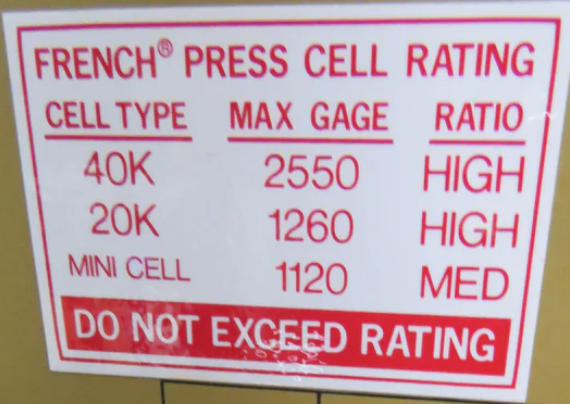
This listing is for a SLM AMINCO (THERMO IEC today) FRENCH PRESSURE CELL LABORATORY PRESS Number 7 with 3000 psi & Extra Pressure Cell as can be WATCHED IN THE VIDEO and also seen in the pictures.
Please feel free to watch a video of this specific AMINCO FRENCH PRESS working by clicking https://www.youtube.com/watch?v=pitc8phK258
Feel free to download and read Operational Manual for this unit by Googling the following link: conquerscientific.com/wp-content/uploads/2022/10/thermo-iec-french-press_operators-manual.pdf
This IEC AMINCO number 7 French Press was tested and performed fine.
Everything looks really beautiful inside this press, please check inside pictures.
We were told it wasn't used much at all, it just sat in storage for so long you can see some oxidation on the outside, inside it really looks really as if very rarely used as you can see from the pictures.
- 120 volts Standard Outlet
- 100 Watts
These units are the best piece of laboratory equipment for isolation of thermally sensitive or difficult to solubilize prokaryotic or eukaryotic fusion proteins!
We have completely inspected the unit to insure integrity of the hydraulics, no leaks.
Press case is painted with rust proof oil-based pain. Hydraulic fluid is full.
Power Specifications for the Hydraulic Press
Voltage/Amperage: 115V/15A
CONDITION
Received from a laboratory environment. Power tested, and press moves up and down.
INCLUDES
SLM Aminco FA-078 FRENCH Pressure Cell Press 115V
Power cord
WARRANTY
90 Day warranty. We pledge to offer the best service and warranty to all of our customers! We are extending a 90 Day warranty on this item. This is our way of saying thank you for allowing us to serve you.
CERTIFICATION
This is a genuine product from this manufacturer.
More Information on French Presses in Italics Blue were taken from the Web below:
Description and Uses
The FRENCH Pressure Cell is a dispersion unit for disintegrating chloroplast material, blood cells, unicellular organisms, homogenates of animal tissue, and other biological particles. Use of the pressure cell allows destruction of the cellular walls of a sample while leaving the cell nucleus undisturbed.
The French pressure cell or “French press”, invented by Stacy French of the Carnegie Institution of Washington, D. C., is used to disrupt cells by passing them through a narrow valve under high pressure. It can disrupt plant and microbial cell walls while leaving the nuclei intact. Other uses include disintegrating chloroplasts, animal tissue homogenates and other biological particles. A French press is commonly used to break the resilient cell walls of bacteria and other microorganisms for isolation of proteins, enzymes and other cellular components. The press uses a hydraulic pump to drive a piston within a larger cylinder that contains the liquid sample. The highly pressurized sample is then squeezed through a needle valve during which the fluid undergoes shear stress and decompression, causing cellular disruption. The major components of the press are made of stainless steel to prevent sample contamination. In the press, shear forces are carefully controlled by adjusting the piston pressure. The press provides a single-pass through the point of maximum shear force, limiting damage to delicate biological structures due to repeated shear, as can occur with other disruption methods. Before use, the pressure cell is chilled to preserve enzymatic and other biological activities of the sample. Disadvantages of the press include its inapplicability for large sample volumes, and its difficulty to move, manipulate and clean due to its heavy weight (~15 Kg). Additionally, certain types of samples may clog the valve.
FRENCH Presses are the primary sample preparation tools in protein studies, extraction of nucleic acids and cell disruption of various prokaryotic and eurkaryotic cells, among others.
The press provides a rapid, inexpensive and effective mechanical means for gentle disruption of cell membranes and cell walls including nuclear membranes and mitochondrial membranes.
This pressure-induced process results in more uniform and complete disruption than possible with other mechanical, ultrasonic, or harsh chemical methods.
These units are particularly effective for isolation of often insoluble bacterial fusion proteins.
This FRENCH Presses can exert of up to 3,000 psi of internal pressure resulting in excellent performance.
This hydraulic motor Driven Laboratory Press is easy to operate and offers the advantages of dual-range, single control pressure selection.This provides a regulated working pressure throughout the entire operating stroke, resulting in uniform and complete disruption. Fine control of the internal cell pressure expands and extends the range of the system for use in a variety of different applications.
Weight (net) 340 lbs
Weight (shipping) 389 lbs
Power Required 115 V, 60 Hz, 50 Hz
Applications
• Enzyme preparation and isolation
• Cell extract preparation
• Bacterial and plant tissue disintegration
• Recovery of intercellular proteins and nucleic acid
• Preparation of viral antigens for EIA test kits
• Membrane preparation for phizobia and pseudomonads
• Disruption of cells for pigment analysis.
The French pressure cell press, or French press, is an apparatus used in biological experimentation to disrupt the plasma membrane of cells by passing them through a narrow valve under high pressure. The French Press can also be used for disintegration of chloroplasts, homogenates of animal tissue and other biological particles. It is capable of disrupting cell walls while leaving the cell nucleus undisturbed. The French press was invented by Charles Stacy French of the Carnegie Institution of Washington.
The press uses an external hydraulic pump to drive a piston within a larger cylinder that contains the liquid sample. The highly pressurized sample is then squeezed past a needle valve. As the sample passes through the valve, the fluid experiences shear stress and decompression, causing cellular disruption. The major components of a French press are made of stainless steel to prevent sample contamination.
A French press is commonly used to break the resilient plasma membrane and cell walls of bacteria and other microorganisms for isolation of proteins and other cellular components. The disruption of cells in a French press generates 'inside-out' membrane vesicles which are required for many in vitro biochemical assays. The cell is typically chilled overnight before use to preserve enzymatic activities. Disadvantages of the press include that it is not well suited to processing of large sample volumes, and is somewhat awkward to manipulate and clean due to the weight of the assembly (about 30 pounds (14 kg)). Certain types of samples may clog the valve.
Other technologies, such as sonication and ball mills, are available for many of the same purposes, and have their own advantages and disadvantages. For example, sonication can generate high shear forces that break cellular DNA into small fragments. With a French press, the shear force can be carefully modulated by adjusting the piston pressure. The Press provides a single pass through the point of maximum shear force, limiting damage to delicate biological structures due to repeated shear, as occurs in other disruption methods.
Stock # 131811
Couldn't load pickup availability
Low stock: 1 left
View full details